

Focus Vertical 06

Infrastructure

The physical backbone of trade, mobility, and development.

  • $15TGlobal gap by 2040
  • 7.2%Infrastructure CAGR
  • $1 : $4Capital mobilised per $1
  • 6Focus areas

Overview

Infrastructure is where development becomes tangible — ports, corridors, water, digital backbones, and the resilient systems that protect them. The coalition finances the assets that lower the cost of doing everything else.

Investment thesis

The global infrastructure gap runs to roughly $15 trillion by 2040, concentrated in the economies that can least self-finance it. De-risked, blended capital is the only realistic path to closing it at pace.

Inception
2019
Regions
Américas · África · Asia
Instruments
Guarantee · Concessional loan · Blended finance · Equity
2030 target
22 # of 40 #
Data as of
July 2026

Focus areas

  • Ports & logistics
  • Water & sanitation
  • Digital backbone
  • Resilience
  • Urban systems
  • Corridors

Structural themes

The forces reshaping infrastructure — and where the coalition positions against them.

  1. The $15 trillion gap

    The financing gap is concentrated where economies can least self-finance it; blended capital is the only realistic bridge.

  2. Digital and resilient assets lead

    Fibre, data centres, and climate-resilient design outgrow legacy infrastructure.

  3. Trade-cost compression

    Ports and corridors that lower logistics costs compound across the whole economy.

  4. Availability-based revenue

    Contracted, availability-based structures deliver long-duration, inflation-linked cash flows.

How we invest

  1. Originate with members

    Pipeline is sourced through member central banks and finance ministries, so every commitment is aligned to a national priority from day one.

  2. Blend & de-risk capital

    Concessional capital, guarantees, and first-loss layers are structured to crowd in private and institutional money at multiples of the coalition’s own outlay.

  3. Build local capacity

    Every deal carries a capacity-development component — institutions, skills, and data — so results outlast the financing.

  4. Measure & report

    Outcomes are tracked against a results framework and independently evaluated, then published — closing the loop between capital and impact.

The opportunity

The coalition is active across 4 focus areas within infrastructure, concentrating capital where the return on development is highest. Indonesia anchors the current book, while the forward pipeline signals where the next tranche of capital is heading. Because the frontier layer compounds faster than the broad sector, early and patient positions capture a disproportionate share of the value created.

Managing the risk

These are real markets carrying real currency, policy, and execution risk, and the strategy is built to absorb it. Guarantees, first-loss layers, and blended concessional capital sit between partners and volatility, and no infrastructure position is taken without a clear path to refinancing or exit. Independent evaluation then reviews every outcome against the original thesis and reports above management, not to it.

Beyond capital

Capital alone rarely sticks. Each infrastructure commitment pairs financing with the institution-building, data, and skills that let results outlast the loan — so a single project seeds capacity that compounds across the wider economy long after the coalition has been repaid.

Regional lens

Across the coalition’s three secretariats, Asia carries the deepest infrastructure book today — roughly $0.9B committed with a further $0.7B in pipeline. The Américas, África, and Asia each source their own deals, so the portfolio reflects genuinely different market structures rather than a single template applied everywhere.

The data at a glance

Infrastructure — market context, coalition portfolio, and impact, visualised. Figures are illustrative for this build.

  1. $15T Global gap by 2040
  2. 7.2% Infrastructure CAGR
  3. $1.9B Coalition infra portfolio
  4. $1 : $4 Capital mobilised per $1

Market context & momentum

Infrastructure is among the largest and fastest-moving arenas in development finance, and the coalition treats it as a core allocation rather than a thematic bet. Scale here is measured in the trillions, but the number that drives returns is the rate of change — and on that measure the technology frontier is pulling steadily away from the sector average.

Exhibit 01 rebases the broad sector against that frontier; the widening gap between the two lines is the excess return available to early, patient capital. Exhibit 02 tracks the coalition's own deployment into infrastructure, which has compounded year on year as pipeline has converted into signed commitments. Indexed to 2020 = 100. Digital & resilient infrastructure (frontier) leads the broad sector.

Exhibit 01Sector vs. frontier growthindexed, 2020 = 100
202020222024202620282030
FrontierSector

Indexed to 2020 = 100. Digital & resilient infrastructure (frontier) leads the broad sector.

Exhibit 02Capital inflows$B / yr
202020222024202620282030

Coalition capital into infrastructure has scaled toward $2.3B a year — a proxy for deployment momentum.

The shape of the book

Not all of infrastructure is equal. Activity concentrates in a handful of sub-sectors where capital and capacity can be combined to real effect, and that mix rebalances as markets mature and new segments open up. Reading the shape of the book is the first step in judging both its resilience and its room to grow.

Exhibit 03 breaks the vertical into its components — Ports & logistics leads at 26% of exposure — while Exhibit 04 sets committed capital against the forward pipeline across the coalition's three regional secretariats, a direct read on where the next tranche of deployment is heading.

Exhibit 03Sub-sector share% of vertical
PortsWaterDigitalResilienceUrban

Ports & logistics is the largest area of activity, at 26% of vertical exposure.

Exhibit 04Committed vs. pipelineby region, $B
AméricasÁfricaAsia
CommittedPipeline

Committed capital against the forward pipeline, by region — a read on where infrastructure deployment is heading.

How capital is structured & deployed

How a deal is financed matters as much as how much. The coalition rarely lends on balance sheet alone; each infrastructure commitment is engineered to crowd in private and institutional capital at a multiple of the coalition's own outlay, so a fixed pool of concessional money moves far more than its face value.

Exhibit 05 shows the instrument mix shifting over time toward blended and guarantee structures that share risk and unlock third-party money. Exhibit 06 ranks single-economy exposures — led by Indonesia at $350M — with concentration kept deliberate but bounded, so no single market is allowed to dominate the book.

Exhibit 05Instrument mix% by year
2022 2024 2026
ConcessionalBlendedGuaranteeEquityGrant

The financing mix is shifting toward blended structures that crowd in private and institutional capital.

Exhibit 06Top economiesexposure, $M
Indonesia $350 Egypt $290 Philippines $330 Mexico $310 Guyana $240

Indonesia carries the largest single-economy exposure, at $350M.

Allocation & impact

Where the coalition places its conviction, and what that conviction produces, are two sides of the same page. Allocation is weighted toward the areas with the highest development return, and every dollar committed is underwritten against a published results framework rather than a headline.

Exhibit 07 shows committed capital across focus areas — weighted toward ports & logistics at 32% — and Exhibit 08 profiles measured impact across five dimensions, strongest on trade cost ↓. These are the outcomes independent evaluation reviews, and the ones the coalition publishes when a project completes.

Exhibit 07Allocationby focus area
4 areas
  • Ports & logistics 32%
  • Water 24%
  • Digital backbone 24%
  • Resilience 20%

Allocation concentrates in ports & logistics, at 32% of the book.

Exhibit 08Impact profile0–100
Trade cost ↓ResilienceAccessJobsEmissions

On the results framework, measured impact is strongest on trade cost ↓.

Risk, targets & delivery

Return is only half the mandate; the other half is managing risk and delivering against a clear 2030 target. These are real markets with real currency, policy, and execution risk, and the strategy is built to absorb that volatility while still deploying at scale.

Exhibit 09 plots each sub-sector by risk and return, sized by the capital at work — frontier plays sit upper-right and are deliberately balanced by steadier positions elsewhere. Exhibit 10 tracks progress toward the 2030 target, and Exhibit 11 shows delivery against four operating KPIs — the numbers the coalition reports as rigorously as it reports capital.

Exhibit 09Risk / returnbubble = capital
Risk → Ports Water Digital Resilience

Each bubble is a sub-sector, sized by capital at work; frontier plays sit upper-right — higher return, higher risk.

Exhibit 102030 targetprogress
55%

22 # of 40 # — progress to 2030 assets target

Exhibit 11Key performance indicatorsvs. target
  • Assets delivered vs target55%
  • Trade-cost reduction48%
  • People served58%
  • Private capital mobilised62%

Delivery is tracked against target across four key performance indicators.

Exhibits are illustrative for this build and shown for context only. Sources: World Bank Open Data, published sector market research, and UEDF analysis. Indexed series are rebased to 2020 = 100.

Risk factors & mitigants

Every position is underwritten against a defined set of risks, each with a structural mitigant.

  1. Risk

    Construction and completion risk

    Mitigant

    Staged disbursement and experienced sponsors cap delivery risk.

  2. Risk

    Political and regulatory change

    Mitigant

    Stabilisation clauses and multilateral guarantees protect long tenors.

  3. Risk

    Demand and usage risk

    Mitigant

    Availability-based contracts shift volume risk away from the asset.

  4. Risk

    FX mismatch on long tenors

    Mitigant

    Local-currency and hedged structures align revenue and debt.

Outlook to 2030

Through 2030, the coalition expects infrastructure to remain a core allocation. Indexed to 2020 = 100. Digital & resilient infrastructure (frontier) leads the broad sector. The near-term priority is converting pipeline into signed commitments while advancing toward the 2030 target — currently about 55% complete. Frontier sub-sectors carry more risk but anchor the return, and are balanced by steadier, income-generating positions elsewhere in the book.

Commitments in Infrastructure

All commitments
  1. Committed Guyana · Américas

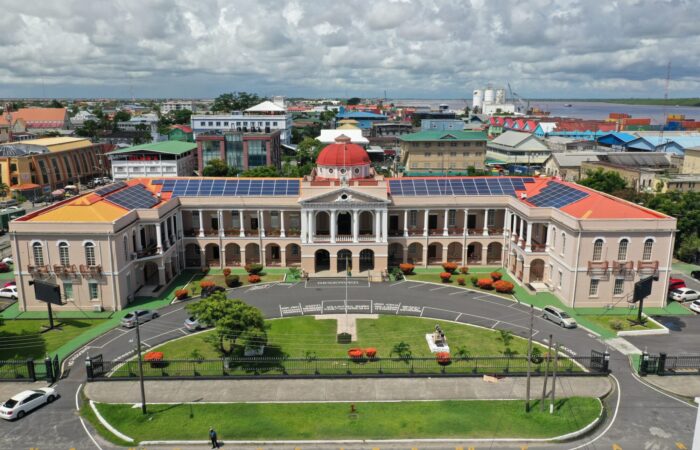
    Demerara river crossing

    A high-capacity crossing unlocking the capital’s eastern growth corridor.

    $240M Guarantee · 2025
  2. Committed Mexico · Américas

    Northern logistics corridor

    De-risking a multimodal freight corridor linking clusters to ports.

    $310M Guarantee · 2025
  3. Committed Egypt · África

    Suez logistics upgrade

    Warehousing and handling capacity around the canal economic zone.

    $290M Guarantee · 2025
  4. Committed Indonesia · Asia

    Archipelago port modernization

    Upgrading secondary ports to lower inter-island trade costs.

    $350M Guarantee · 2025
  5. Committed Philippines · Asia

    Metro Manila flood resilience

    Drainage, pumping, and nature-based defences against flooding.

    $330M Concessional loan · 2025
  6. Committed Kenya · África

    Mombasa port expansion

    Berths and handling capacity for the eastern trade gateway.

    $360M Guarantee · 2025
  7. Active Colombia · Américas

    National water & sanitation

    Treatment and networks extending safe water to secondary cities.

    $280M Concessional loan · 2024
  8. Active India · Asia

    Digital fibre backbone

    Long-haul fibre linking data centres to under-served districts.

    $420M Blended finance · 2023
  9. Pipeline Philippines · Asia

    Regional airport upgrades

    Runway and terminal upgrades connecting secondary island economies.

    $310M Guarantee · 2026
  10. Committed Nigeria · África

    Urban drainage & resilience

    Drainage and flood defences for fast-growing coastal cities.

    $200M Concessional loan · 2025

Insights & commentary

All insights
  1. 2 years ago · Commentary Essential Multilateral Development Banks for the Global Community
  2. 3 years ago · Analysis Unlocking the $6 Trillion Potential in Artificial Intelligence
  3. 3 years ago · Commentary Strategies of the Far-Right in Establishing American Authoritarianism

Important information. This page is for information only and does not constitute an offer, solicitation, or recommendation to invest, nor investment, legal, tax, or financial advice. All figures are illustrative for this build; market data is drawn from public sources including the World Bank and published sector research, and coalition figures are indicative and unaudited. Data is presented as of July 2026. Forward-looking statements and targets are subject to change and are not guarantees of future results; past performance is not indicative of future results. Every commitment is subject to independent evaluation under Accountability.